
WELCOME BONUS 300%
UP TO €2000 + 100
FREE SPINS
UP TO €2000 + 100
FREE SPINS
Home → Games
Casino games at Talismania
Straight 35:1 Against the Chance of 1 in 37
A Straight bet in European Roulette offers a payout of 35 to 1. This bet covers a single number on the wheel, which contains 37 sectors including a single zero. The house edge on this bet, and all others in European Roulette, is consistently 2.70%. Understanding this edge is crucial for beginners to gauge the inherent casino advantage on each wager.
The theoretical Return to Player (RTP) for European Roulette is 97.30%, directly stemming from the 2.70% house edge. This means, on average, players can expect to retain 97.30% of their wagers over an extended period of play. For a new player, this figure indicates the long-term cost of playing the game.
Compared to American Roulette, which features a double zero and 38 sectors, the European version is more favourable. The additional sector on the American wheel doubles the house advantage to 5.26%. Therefore, beginners will find that placing Straight bets on a European wheel offers a statistically better chance of retaining their funds.
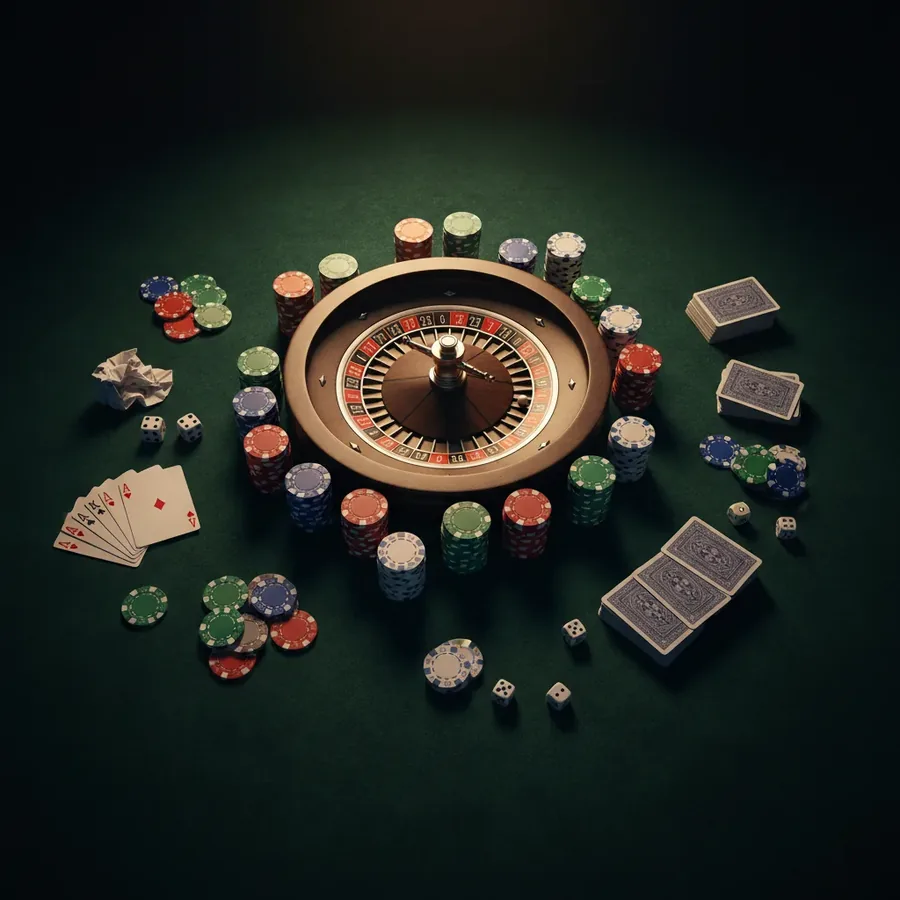
Straight, Split, and Corner: Three Terms Briefly Explained
In Roulette, a Straight bet is a wager on a single number, yielding a payout of 35:1. In European Roulette, with 37 sectors, this bet has a house edge of 2.70%. Beginners should note that while payouts are high, the frequency of winning on a single number is statistically low.
A Split bet covers two adjacent numbers on the betting layout, paying 17:1. This bet also operates within the 2.70% house edge of European Roulette. Understanding these different bet types allows new players to vary their gameplay and risk exposure within the same game.
A Corner bet, also known as a Square bet, covers four numbers that meet at a corner on the layout, paying 8:1. Like Straight and Split bets, the Corner bet is subject to the 2.70% house edge in European Roulette. This provides new players with a range of options from single-number focus to broader coverage.
37 vs. 38 Sectors: What the Double Zero Costs
European Roulette features 37 sectors, comprising numbers 1 through 36 and a single zero (0). This configuration results in a house edge of 2.70% on all bets. For beginners, this is the standard and more player-friendly version of the game due to its lower inherent casino advantage.
American Roulette, in contrast, adds a double zero (00) to the wheel, bringing the total number of sectors to 38. Despite payouts remaining similar to European Roulette (e.g., Straight bet at 35:1), this extra sector significantly increases the house edge to 5.26%.
The impact of the double zero on the player is substantial; it effectively doubles the casino's advantage. For a player, this means that for every €100 wagered over the long term, an average of €5.26 is returned to the casino on American Roulette, compared to €2.70 on European Roulette.
When is Splitting Aces and Eights Sensible?
In Blackjack, splitting Aces is generally a favourable decision, as it allows players to start two new hands, each with a strong potential value of 11. The rules for Aces often involve receiving only one additional card after the split, a common feature in many Blackjack variants.
Splitting Eights is also often recommended in Blackjack strategy, particularly when the dealer's upcard is unfavourable. Eights are considered a weak starting hand, and splitting them can create two potentially stronger hands rather than continuing with a total of 16, which is a poor hand to play.
Specific rule variations can influence the decision to split. For instance, the availability of 'Double After Split' (DAS) can make splitting more advantageous by offering increased betting opportunities on newly formed hands. The RTP for Blackjack Liberal Vegas Strip, with favourable rules like S17 + DAS + Resplit + Late Surrender, is 99.72%.
En Prison on Zero Gives Second Chance
The 'En Prison' rule in French Roulette offers a second chance on even-money bets when the ball lands on zero. If a wager is placed on Red/Black, Odd/Even, or Low/High, and the outcome is zero, the bet is not immediately lost but is 'imprisoned' for the next spin.
If the imprisoned bet wins on the subsequent spin, it is returned to the player without profit. This rule effectively reduces the house edge on these specific even-money bets. For example, French Roulette with La Partage on even chances has an RTP of 98.65% and a house edge of 1.35%.
The 'La Partage' rule is functionally similar to 'En Prison' for even-money bets, also refunding half the stake when zero appears. While 'En Prison' holds the bet for the next round, 'La Partage' simply returns half the stake immediately. Both rules significantly improve the player's statistical position on these bets compared to standard European Roulette.
Game categories at a glance
| Category | Examples | Stakes From | Highlight |
|---|---|---|---|
| Slots | Nitropolis 4, Gates of Olympus, 9 Coins Grand Gold Edition | 0,10 EUR | thousands of titles |
| Table games | Roulette, Blackjack, Baccarat | 0,50 EUR | classic rules |
| Live casino | Dream Catcher, Blaze Roulette | 0,20 EUR | real dealers |
| Jackpot games | Mega Moolah, Divine Fortune, Age of the Gods | 0,20 EUR | progressive pools |
| Instant games | Aviator, Plinko, Mines | 0,10 EUR | fast rounds |
| Video poker | Jacks or Better, Deuces Wild | 0,25 EUR | strategy based |
Game Shows: sectors, multipliers, and bet ranges
Certain table games, while not strictly 'game shows,' operate on a wheel with sectors. French Roulette, for instance, utilizes a wheel with 37 sectors when played with the La Partage rule. Bets on even chances like Red/Black or Odd/Even have a 1:1 payout, but the presence of a '0' sector triggers the La Partage rule, returning half the stake.
The concept of multipliers is not directly applicable to traditional table games like Roulette or Blackjack in the same way it is to slot bonus features. While some table games offer higher payouts for specific inside bets, such as a 35:1 payout on a Straight bet in American Roulette, these are fixed odds rather than variable multipliers. The maximum payout on an inside bet in American Roulette remains 35:1, regardless of how many times it is bet.
The bet ranges for these games can vary significantly, offering flexibility for different player preferences. For example, while a straight bet in Roulette pays 35:1, a Six Line bet offers a 5:1 payout, and Dozen or Column bets pay 2:1. Understanding these varied payouts is key to navigating the betting options within these casino staples.
Variance at the Table: 1:1 vs. 35:1
The difference between a 1:1 payout and a 35:1 payout represents a significant shift in variance for table game players. A 1:1 payout, as seen on even-chance bets in French Roulette (excluding the '0' sector's impact), offers frequent, smaller wins. The RTP for French Roulette with La Partage is 98.65%, indicating a relatively low house edge of 1.35% on these bets.
Conversely, a 35:1 payout, typically for straight bets on a single number in Roulette, offers a much higher potential reward but with significantly lower frequency. While the payout is substantial, the chance of hitting such a bet is considerably lower. This higher variance means players might experience longer losing streaks punctuated by rare, large wins.
For beginners, understanding this variance is crucial. A 1:1 bet on Red/Black in Roulette at €10 could result in winning €10, maintaining the stake. A €10 straight bet on a single number, if successful, would yield €350, but the probability of this occurring is much lower than winning an even-chance bet. The house edge for American Roulette, which also features 35:1 payouts on inside bets, is considerably higher at 5.26%.
Why the Double Zero Almost Doubles the House Edge
The inclusion of a double zero ('00') in American Roulette fundamentally alters the game's mathematical structure compared to European or French Roulette. An American Roulette wheel features 38 sectors (numbers 1-36, '0', and '00'), whereas a European wheel has only 37 sectors (1-36 and '0'). This additional sector directly impacts the probabilities of all bets.
The house edge is a direct consequence of the number of possible outcomes versus the payout structure. In American Roulette, the RTP is 94.74%, resulting in a house advantage of 5.26%. This is almost double the house edge of European Roulette, which sits at 2.70% with an RTP of 97.30%, because the '00' sector provides an extra winning opportunity for the casino on many bets without altering the payout ratios for players.
For a beginner, this means that for every €100 wagered on American Roulette, an average of €5.26 is retained by the casino, compared to an average of €2.70 on European Roulette. This difference, stemming solely from the presence of the double zero, makes European Roulette a mathematically more favourable game for players seeking better long-term value.
Baccarat in three steps: bet, reveal, compare
Baccarat offers a straightforward gameplay loop that makes it accessible for new players. The first step involves placing a bet on one of three outcomes: the Player hand, the Banker hand, or a Tie. For instance, betting on the Player hand in an 8-deck game offers a 1:1 payout and has an RTP of 98.76% with a house edge of 1.24%.
Following the bet, the Player and Banker hands are dealt two cards each, and their total values are revealed. The objective is to get as close to a total of nine as possible. If neither hand reaches nine, a third card may be drawn based on specific rules. Understanding these rules is beneficial, although the Banker bet, despite a 5% commission, has a slightly higher RTP of 98.94% and a lower house edge of 1.06%.
Finally, the hands are compared to determine the winner. The bet placed on the winning hand is paid out according to the game's rules. For example, a winning Banker bet is paid at 0.95:1 due to the 5% commission. A Tie bet, typically paying 9:1, has a significantly higher house edge of 4.84%, making it less favourable than betting on Player or Banker.
100 EUR bet, 50 rounds: the expected value
To calculate the expected value over 50 rounds with a €100 bet each round, one must consider the house edge. For Baccarat Player bets, with a house edge of 1.24%, the expected loss over 50 rounds would be €100 (bet per round) * 50 (rounds) * 0.0124 (house edge), equating to €62.
If the bet was placed on Blackjack with a 6:5 payout and a house edge of 1.85%, the expected loss would be calculated as €100 * 50 * 0.0185, resulting in €92.50. This Blackjack variation, where a €10 bet pays €12 instead of €15, significantly increases the casino's advantage compared to standard 3:2 payouts.
For French Roulette with the La Partage rule on even chance bets, the house edge is 1.35%. Therefore, the expected loss for a €100 bet over 50 rounds would be €100 * 50 * 0.0135, which totals €67.50. This illustrates how even small differences in house edge can impact expected outcomes over repeated play.
RNG Roulette vs. Live Table: Four Clear Differences
RNG European Roulette offers a theoretical Return to Player (RTP) of 97.30%, with a house edge of 2.70%. This is consistent across all betting types, from a 35:1 payout on a Straight bet to a 1:1 payout on Red/Black. The absence of a dealer in RNG games allows for faster gameplay and a continuous betting environment.
In contrast, Live French Roulette with La Partage on even-chance bets (like Red/Black) provides an RTP of 98.65%, reducing the house edge to 1.35%. This rule, which refunds half the stake on a zero, significantly benefits players on these specific wagers. Standard internal bets remain unaffected by La Partage.
American Roulette, featuring both a single and double zero, presents a significantly higher house edge of 5.26% with an RTP of 94.74%. This is due to the 38 sectors on the wheel compared to the 37 sectors on European and French wheels. The payouts for internal bets, such as a 35:1 for a Straight bet, remain the same as European roulette.
Martingale Fails After 8 Rounds at Table Limit
A common betting strategy, the Martingale system, involves doubling the bet after each loss. In Blackjack, for example, starting with a €10 bet and doubling it for 8 consecutive rounds would lead to a total wager of €2,550. This escalation quickly approaches typical table limits, making further progression impossible.
The European Roulette wheel has a house edge of 2.70% on all bets. If a player were to employ the Martingale strategy on an even-chance bet like Red/Black, which pays 1:1, the cumulative losses after 8 rounds could exceed the table maximum, resulting in the strategy's failure.
Consider a scenario where a player attempts to recover losses using the Martingale system. After 7 losses, the bet would be €1,280. If the 8th round also results in a loss, and the table limit is €1,000, the player cannot place the required €2,560 bet, thus breaking the progression.
Corner Pays 8:1, Dozen Only 2:1
European Roulette offers a variety of payout structures for its diverse betting options. A Corner bet, covering four numbers, pays out at 8:1. This means a €10 bet would yield €80 in winnings, plus the original stake returned.
In contrast, a Dozen bet, covering twelve numbers (e.g., 1-12, 13-24, or 25-36), pays out at a lower rate of 2:1. A €10 wager on a Dozen would result in €20 in winnings, plus the stake. This significantly lower payout reflects the broader coverage of the bet.
The house edge on European Roulette is 2.70% across all bets, irrespective of the payout ratio. While the Dozen bet covers more numbers, its lower payout makes it less attractive on a per-unit basis compared to the higher-paying Corner bet, despite both sharing the same overall house advantage.
How Much Does One Mistake Cost in 100 Hands?
A single rule variation can significantly impact the house edge in Blackjack. For instance, changing the payout for a Blackjack from 3:2 to 6:5, as seen in a 6-deck game, increases the house advantage by 1.39 percentage points. This brings the house edge to 1.85%, from a more favourable 0.46% if the 3:2 payout was maintained.
Consider playing 100 hands of Blackjack with a 6:5 payout for a Blackjack, where the house edge is 1.85%. Over these 100 hands, the theoretical average amount retained by the casino would be 1.85% of the total wagered amount. If each hand wagered €10, this would equate to €18.50 retained by the casino on average.
If the same 100 hands were played with a more favourable 3:2 payout for Blackjack, the house edge would be substantially lower. This means that a single rule change from 3:2 to 6:5 for Blackjack payouts directly costs the player an additional 1.39% of their total bets over time.
How many sectors does the Game Show wheel have?
The European Roulette wheel is comprised of 37 sectors, numbered 1 through 36, plus a single zero (0). This configuration results in a consistent house edge of 2.70% for all bets placed on the table, as the payouts are based on 36 numbers despite the wheel having 37 outcomes.
American Roulette, however, features an additional sector, the double zero (00), bringing its total to 38 sectors. Despite offering the same payout ratios as European Roulette (e.g., 35:1 for a Straight bet), this extra sector doubles the house edge to 5.26%, making it less favourable for players.
French Roulette, with the 'La Partage' rule applied to even-chance bets, offers an RTP of 98.65%, with a house edge of 1.35%. This version also uses a wheel with 37 sectors, similar to European Roulette, but the rule regarding the zero significantly alters the house advantage on specific bet types.
Contact
Live - online chat
Banking









Providers












Talismania Casino 2026