
WELCOME BONUS 300%
UP TO €2000 + 100
FREE SPINS
UP TO €2000 + 100
FREE SPINS
Home → Blackjack
Blackjack at Talismania: Variants, Rules and Payouts
Early Surrender is removed from many tables
The Blackjack Liberal Vegas Strip offers Late Surrender, allowing a player to forfeit half their bet after the dealer checks for blackjack. This rule modifier improves the RTP by approximately 0.08 percentage points. While Early Surrender can offer a more substantial RTP improvement of up to 0.6 percentage points, it is exceptionally rare in online blackjack variations.
For beginners, understanding the impact of surrender rules is crucial for optimising gameplay. Late Surrender at Talismania casinos provides a small but welcome reduction in the house edge. This feature is available on certain blackjack variants, such as Blackjack Liberal Vegas Strip, which boasts an RTP of 99.72%.
The absence of Early Surrender on many tables means players cannot surrender their hand before the dealer checks for blackjack. This is a key difference for novice players to note, as it limits strategic options compared to tables offering both surrender types. Therefore, players should verify the specific rules of each blackjack game before playing.
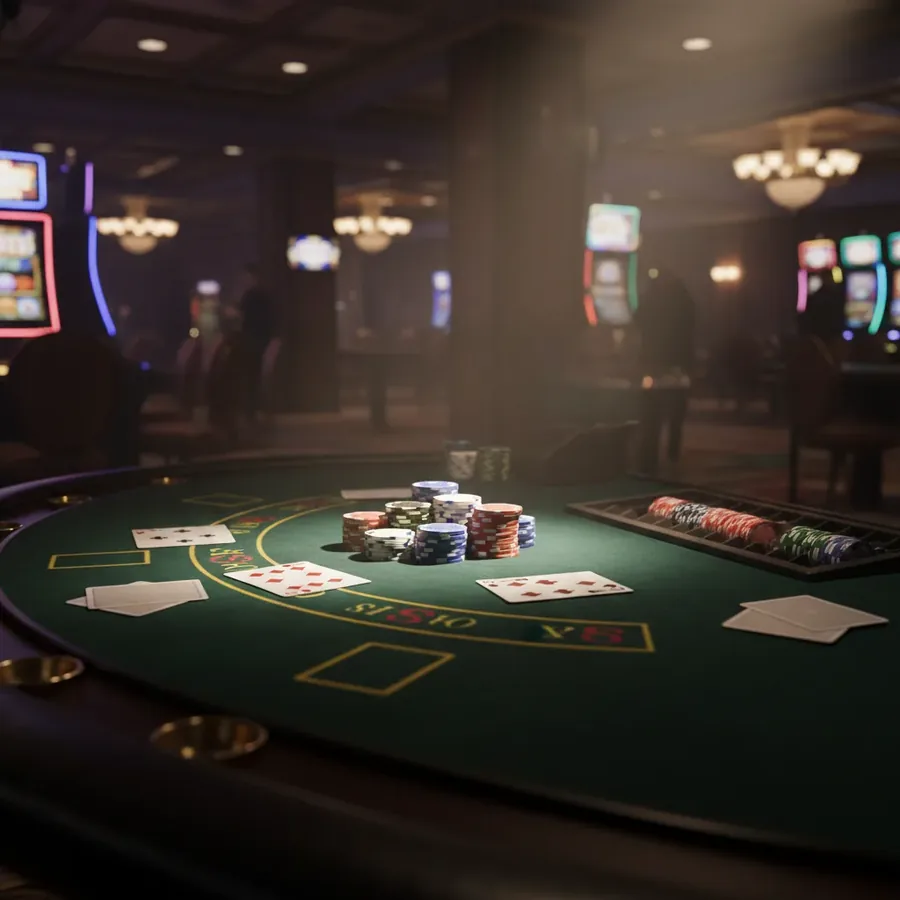
Splitting tens costs expected value: better stand
Blackjack games with liberal rules, such as Blackjack Liberal Vegas Strip (RTP 99.72%), often allow splitting tens. However, basic strategy dictates that splitting tens is generally not advisable, as it can increase the house edge. This is because a starting hand of two tens already represents a strong position with a value of 20.
The decision to split tens, even with favourable rules like Double After Split (DAS), which improves RTP by 0.14 percentage points, should be carefully considered. While some blackjack variants allow splitting any pair, including tens, the optimal strategy prioritises standing on 20. The house advantage can increase if players deviate from this fundamental principle.
For players aiming to minimise the house advantage, standing on a total of 20 is consistently the superior choice, even if splitting is permitted. This approach aligns with the standard deviation of 1.15 for tables with generous rules and a 3:2 blackjack payout. Adhering to basic strategy ensures the best possible RTP.
What Percentage Does Blackjack Count Towards Bonus?
Blackjack games contribute only 10% towards meeting the wagering requirements of bonuses offered at Talismania. This means that for every €100 wagered on blackjack, only €10 will count towards clearing the bonus. This is significantly lower than the contribution from slot games, which count at 100%.
The welcome bonus at Talismania is a 300% match up to €2,000, plus 100 free spins. If a player claims the full €2,000 bonus, they would need to wager €20,000 through blackjack to meet the requirements (€2,000 bonus / 10% contribution = €20,000 in wagers). This calculation highlights the slower progress with table games.
For new players aiming to utilise their welcome bonus effectively, understanding these contribution rates is essential. While blackjack offers a high RTP, its low bonus contribution rate means players may need to significantly increase their playing time or focus on slots to fulfil wagering conditions within a given timeframe.
How many decks are in the shoe?
The number of decks used in a blackjack shoe can vary, impacting the house edge. Blackjack games with fewer decks generally offer a lower house advantage. For instance, a single-deck game can have a house edge of approximately 0.15%, significantly lower than an eight-deck game.
While a single-deck game with classic rules and a 3:2 payout offers a superior RTP of 99.85%, it's often compensated with less favourable rules like a 6:5 payout on blackjack. The difference of just 0.02 percentage points in house edge exists between 6 and 8 decks, a minor factor compared to payout rules.
Many online blackjack variants, including those at Talismania, utilise multiple decks. For example, Blackjack Insurance, which has a significant house edge of 7.47% with 6-8 decks, demonstrates how deck count and specific side bets interact. Beginners should look for games with a 3:2 payout and fewer decks to minimise the casino's advantage.
Side Bet Every Round: Budget Lasts 30 Rounds
Engaging in side bets on every round of blackjack can rapidly deplete a player's budget, especially when combined with standard betting strategies. For example, if a player wagers €10 on the main hand and €10 on a side bet each round, their total outlay per round is €20.
With a budget of €600, and an outlay of €20 per round including side bets, this budget would indeed last approximately 30 rounds (€600 / €20 per round). This calculation assumes no wins and consistent betting on both the main hand and the side bet.
Side bets such as Blackjack Insurance, with a house edge of 7.47% for 6-8 decks, are generally disadvantageous for players following basic strategy. For beginners, it is often advisable to focus solely on the main blackjack game and avoid side bets to preserve their bankroll and maximise playing time.
Blackjack variants at a glance
| Variant | Payout | House edge | Rule | Bet range |
|---|---|---|---|---|
| Blackjack Auszahlung 6:5 statt 3:2 (6 Decks) | 98.15% | 1.85% | Ersatz von 3:2 durch 6:5 fügt exakt +1.39 Prozentpunkte zum Vorteil des Casinos hinzu – stärker als jede andere Regeländerung. Bei $10 Einsatz zahlt Blackjack $12 statt $15. | Blackjack 6:5, Gewinn 1:1 |
| Blackjack Surrender (Late Surrender) – Regel-Effekt | n.a. (Regel-Modifikator) | −0.08 Prozentpunkte | Spieler gibt Hand nach Dealer-Blackjack-Prüfung auf, verliert die Hälfte des Einsatzes. Verbessert RTP um ca. 0.08 Prozentpunkte. Early Surrender ist wesentlich wertvoller (bis −0.6 Prozentpunkte), aber extrem selten. | Rückzahlung 50% des Einsatzes |
| Blackjack Split / Double / H17 – Regel-Effekte | n.a. (Regel-Modifikatoren) | H17 +0.22 Prozentpunkte; RSA −0.08 Prozentpunkte; DAS −0.14 Prozentpunkte | Dealer Hits Soft 17 verschlechtert RTP um 0.22 Prozentpunkte; Resplit Aces verbessert um 0.08 Prozentpunkte; Double After Split verbessert um ca. 0.14 Prozentpunkte; 6 Decks statt 8 – ca. 0.02 Prozentpunkte. | Double – Einsatz ×2 mit einer Karte; Split – bis 4 Hände; Ass-Split meist mit einer Karte. |
| Blackjack Liberal Vegas Strip (liberale Regeln, 3:2) | 99.72% | 0.28% | Günstigste Regelkombination: S17 + DAS + Resplit + Late Surrender. Standardabweichung 1,15 | Blackjack 3:2, Gewinn 1:1 |
| Blackjack 6 Decks, S17, DAS, DOA, Auszahlung 3:2, Basisstrategie | 99.54% | 0.46% | Dealer steht auf Soft 17; Verdopplung auf jeder Zweierkarte; Verdopplung nach Split erlaubt; keine Aufgabe. Basisstrategie ist für diesen Wert zwingend | Blackjack 3:2, normaler Gewinn 1:1, Insurance 2:1 |
| Blackjack Ein Deck, klassische Regeln, 3:2 | 99.85% | 0.15% | Weniger Decks = niedrigerer Vorteil; ein Deck gibt ca. −0.48 Prozentpunkte gegenüber 8 Decks. Oft durch 6:5 Auszahlung kompensiert. | Blackjack 3:2, Gewinn 1:1 |
What doesn't count towards turnover at 10 percent?
Table games, including blackjack variants, contribute 10% towards the wagering requirements of a bonus. If a player wagers €100 on blackjack, only €10 will count towards fulfilling the turnover. This means that to reach a turnover requirement of €4,000, a player would need to wager €40,000 on table games.
Slots, however, contribute 100% towards the wagering requirements. For example, a €100 wager on slots would count as €100 towards the turnover. This significant difference means that players aiming to clear bonuses quickly may prefer to play slots over table games.
This differential game contribution means that players who primarily enjoy blackjack might find bonus wagering requirements take considerably longer to complete. For a €2,000 welcome bonus with a 40x wagering requirement, this equates to €80,000 in total wagering needed on slots, but €800,000 on table games.
Soft 17: Dealer Hits or Stands
The rule concerning whether the dealer hits or stands on a soft 17 can impact the Return to Player (RTP). When the dealer hits soft 17, it deteriorates the RTP by 0.22 percentage points. This means the house edge increases slightly when this rule is in effect.
Conversely, specific rule modifications can improve the RTP. For instance, allowing a player to resplit aces can improve the RTP by approximately 0.08 percentage points. Double after splitting improves it by about 0.14 percentage points, offering a slight advantage back to the player.
The Blackjack Liberal Vegas Strip variant, for example, features a dealer standing on soft 17 (S17) alongside other liberal rules, resulting in an RTP of 99.72% and a house edge of 0.28%. This combination of favourable rules provides a better player return than many standard blackjack games.
Ignored Basic Strategy Chart: 1 Percent Wasted
Basic strategy in blackjack aims to minimise the house edge by dictating the optimal play for every hand combination. For a standard game of Blackjack 6 Decks with S17, DAS, DOA, and a 3:2 payout, adherence to basic strategy results in an RTP of 99.54% and a house edge of 0.46%.
If a player deviates from basic strategy, the house edge increases. For instance, ignoring the optimal play can lead to a theoretical loss of around 1% of the player's wagers over the long term. This is a significant figure when considering consistent play.
A game like Blackjack Insurance (6-8 Decks) presents a side bet with a house edge of 7.47%. Basic strategy dictates always refusing this insurance bet unless the true count is high, as it significantly reduces the overall RTP for the player.
Six Decks to Eight Decks in the Shoe
The number of decks used in a blackjack shoe can subtly affect the house edge. Using 6 decks instead of 8 in a shoe can reduce the house edge by approximately 0.02 percentage points. While small, this difference can be noticeable over extended play.
A game with Blackjack Ein Deck (Single Deck) offers a superior RTP of 99.85% and a house edge of just 0.15%. This is because having fewer decks generally lowers the house advantage, providing a better return for the player compared to multi-deck games.
However, casinos often compensate for the lower house edge in single-deck games by altering other rules, such as implementing a 6:5 payout for blackjack instead of the traditional 3:2. This change significantly increases the house edge by 1.39 percentage points.
What Hole Card Means at a Live Table
At live blackjack tables, the dealer's hole card is a crucial element influencing player decisions. In games like Lightning Blackjack, which features unlimited players and lightning multipliers up to 25x, understanding the dealer's potential hand is key, despite the rapid pace.
The game Infinite Blackjack, also from Evolution, offers unlimited seats and four side bets, including Any Pair and 21+3. The presence of the dealer's hole card directly impacts the odds of winning these side bets and the main game, influencing strategic choices.
Blackjack Party, another Evolution offering, focuses on a lively atmosphere with two hosts. While the entertainment aspect is high, the fundamental game mechanics remain, and the dealer's hole card still plays a vital role in determining the outcome of each hand and potential payouts.
Splitting Eights vs Standing on 16
When facing a dealer's upcard of 7 or higher, a player holding two eights should split the hand. This strategy aims to improve the player's position by creating two potentially stronger starting hands. The Blackjack 6 Decks variant, with a house edge of 0.46%, supports this fundamental tactic.
Standing on a hard 16 against a dealer's 7 or higher is a common novice mistake, often leading to a loss. This scenario presents a significant disadvantage, as the probability of busting with any card draw is high. Players should understand that drawing on 16 is generally unfavorable in most Blackjack variants.
The decision to split eights is crucial for optimising gameplay in Blackjack 6 Decks, aiming for a theoretical RTP of 99.54%. This action transforms a difficult starting hand into two more manageable ones, each with a better chance of forming a winning total. Deviating from this basic strategy can increase the house advantage.
When can you increase your bet?
In Blackjack 6 Decks, with an RTP of 99.54%, the primary opportunities to increase your bet are tied to advantageous situations identified through basic strategy. While not explicitly detailed for this variant, the principle involves leveraging favourable odds when they arise, such as after a split or a double down.
Certain blackjack variants allow for increased betting after a split or a double down, offering strategic flexibility. For instance, the Blackjack Liberal Vegas Strip, boasting a 99.72% RTP, permits doubling down on any two cards and resplitting, creating moments where a larger bet might be strategically sound.
The decision to increase a bet should always be informed by the game's rules and the player's understanding of basic strategy. In Talismania's offerings, particularly in variants like Blackjack 6 Decks, betting adjustments are best made during favourable circumstances rather than on impulse, ensuring alignment with the game's inherent probabilities.
Soft Hand and Hard Hand Practically Distinguished
A soft hand in blackjack contains an Ace counted as 11, offering flexibility as it can also be counted as 1 if a bust is imminent. For example, an Ace and a 6 form a soft 17. This distinction is vital for players utilising basic strategy in games like Blackjack 6 Decks, which has a 0.46% house edge.
Conversely, a hard hand is one where an Ace must be counted as 1, or a hand without an Ace. A player holding a 10 and a 6 has a hard 16. Understanding this difference is fundamental to making correct playing decisions, especially when the dealer shows a favourable card.
The dealer's rules significantly impact how soft hands are played; for instance, in Blackjack 6 Decks, the dealer stands on soft 17, which is advantageous for the player compared to a rule where the dealer hits soft 17, increasing the house edge by 0.22%. This rule impacts strategic choices for both hard and soft hands.
Blackjack Payout 3:2 Explained in Detail
The Blackjack Payout 3:2 signifies that for every €2 wagered, a winning blackjack hand (an Ace and a 10-value card on the initial two cards) pays out €3 in profit, in addition to the original €2 stake. This payout structure is standard in many variants, including Blackjack 6 Decks, offering a favourable return of 99.54% RTP.
This 3:2 payout is considerably more lucrative than a 6:5 payout, where a €2 bet would only yield €1.20 profit. The difference of 0.80 per €2 bet translates to a significant increase in the player's potential return over time. For instance, Blackjack Auszahlung 6:5 statt 3:2 has a higher house edge of 1.85%.
Opting for games with a 3:2 payout, such as Blackjack 6 Decks, is crucial for players aiming to minimise the house edge, which stands at 0.46% in this specific variant. This payout ratio directly impacts the overall RTP, making it a primary factor in selecting a favourable blackjack table and enhancing long-term play.
Card Counting at Shuffle Master Table: why it fails
Card counting strategies are rendered ineffective at Shuffle Master tables because these machines continuously shuffle the deck after each hand. This constant reshuffling ensures that the composition of the remaining cards is never known, negating the core principle of card counting, which relies on tracking cards drawn from a static shoe.
The primary function of a Shuffle Master is to eliminate the advantage card counters might gain. By introducing a new, randomised deck for every hand, it resets the probabilities and prevents players from tracking high cards or low cards that have been dealt. This makes traditional card counting methodologies obsolete.
While the RTP for Blackjack 6 Decks is 99.54%, the use of a Shuffle Master effectively neutralises any potential edge a player might derive from card counting. This technology ensures a consistent house advantage, making it impossible to gain a statistical edge through tracking card removal from the deck.
Contact
Live - online chat
Banking









Providers












Talismania Casino 2026